
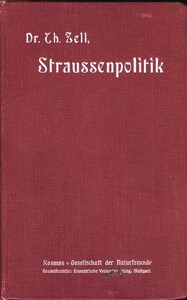
Straußenpolitik : Neue Tierfabeln by Th. Zell
Forget the gentle, moralizing fables you might remember from childhood. Theodor Zell's Straußenpolitik: Neue Tierfabeln is a different beast entirely. Written in the 1890s, this collection uses the animal kingdom as a brilliantly funny, and often savage, satire of human society, politics, and manners.
The Story
There's no single plot, but a series of short, sharp vignettes. Each story features animals acting in very human ways. A vain peacock holds a salon to discuss art and culture, looking down on everyone. A council of mice spends hours debating the perfect theoretical trap, while ignoring the very real cat outside. The title story, 'Ostrich Politics,' shows a group of ostriches in a heated parliamentary debate, each convinced their method of avoiding danger—burying their head—is the most sophisticated and correct. Through these scenarios, Zell pokes fun at everything from bureaucratic nonsense and social climbing to political cowardice and empty intellectualism.
Why You Should Read It
What struck me most was how fresh this over-a-century-old book feels. You'll catch yourself grinning at a donkey's pompous speech, only to realize you've heard a modern politician say something eerily similar. Zell doesn't just mock; he pinpoints universal human flaws. His humor is the key—it disarms you. You're laughing at a clever fox, and then it hits you: you're laughing at us. The book is a quick read, but it sticks with you. It’s like a witty friend pointing out the absurdities of the world over a cup of coffee, except that friend is a 19th-century writer using a talking badger as his mouthpiece.
Final Verdict
This book is perfect for readers who love satire with real teeth, fans of George Orwell's Animal Farm who want to see a lighter (but no less pointed) precursor, and anyone who needs a good laugh at the expense of human folly. It's also a treat for history-minded readers curious about the social climate of pre-WWI Germany. A word of caution: some references are period-specific, but the core jokes about pride, power, and pretense are timeless. If you're looking for a clever, digestible, and surprisingly relevant classic, dig up a copy of Straußenpolitik.
Legal analysis indicates this work is in the public domain. Use this text in your own projects freely.
William Walker
5 months agoBeautifully written.
Joseph Torres
7 months agoFive stars!
Margaret Smith
1 year agoAfter hearing about this author multiple times, the author's voice is distinct and makes complex topics easy to digest. Don't hesitate to start reading.
John Thomas
7 months agoMy professor recommended this, and I see why.



Barbara Allen
1 year agoI started reading out of curiosity and the character development leaves a lasting impact. I learned so much from this.