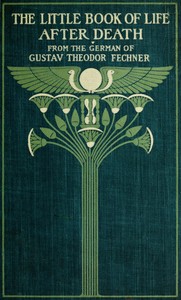
The little book of life after death by Gustav Theodor Fechner
Published in 1836, Gustav Fechner's The Little Book of Life After Death isn't a novel with a plot. Think of it more as a guided thought experiment from a fascinating mind. Fechner was a physicist and psychologist, a man deeply immersed in the material world. This book is his personal project to understand the immaterial.
The Story
There's no traditional narrative. Instead, Fechner builds his case step by step, like a scientist presenting a theory. He starts from the principle that nothing in nature is truly lost; it only changes form. He applies this logic to human consciousness. Our thoughts, feelings, and sense of self—this vibrant inner world—must be a form of energy or natural phenomenon. Since energy is conserved, he reasons, this conscious energy must transition into a new state after the body dies. He imagines this afterlife not as a distant heaven, but as a deeper, more direct connection to the living world and the consciousness of others, freed from the limits of our physical senses. The 'story' is the journey of his argument, from a scientific premise to a spiritual conclusion.
Why You Should Read It
You read this book for the author, not the answers. Fechner's voice is what's captivating. Here's a rigorous 19th-century thinker, trying to be logical about the most illogical of subjects. His earnestness is palpable. He isn't preaching; he's puzzling it out on the page, and you get to follow along. It's less about whether you agree with his conclusions and more about witnessing a brilliant, curious mind confront the ultimate question. It challenges the modern idea that science and wonder are opposites. For Fechner, science was a path to greater wonder.
Final Verdict
This book is perfect for curious readers who enjoy intellectual history, philosophy, or unconventional spiritual reads. It's for anyone who likes to see how people in different eras tackled life's big puzzles. If you want a definitive, religious answer about the afterlife, look elsewhere. But if you want to spend a few hours inside the head of a unique scientist as he tries to map the unmappable with the tools he trusts, this little book is a quiet, thought-provoking gem. Just be ready for a different kind of reading experience.
Legal analysis indicates this work is in the public domain. You are welcome to share this with anyone.