
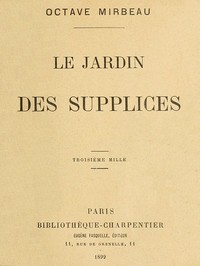
Le jardin des supplices by Octave Mirbeau
Octave Mirbeau's Le jardin des supplices (The Torture Garden) is a book that grabs you and doesn't let go. It's split into two main parts. First, we meet our cynical narrator in Paris. He's fed up with the corruption and lies of politics and society. Feeling hollow, he gets involved with a mysterious and alluring Englishwoman named Clara.
The Story
Clara becomes his obsession. She offers him an escape, taking him on a voyage to China. There, she shows him her personal sanctuary: an exquisitely beautiful garden. But this garden borders a Chinese prison. For Clara, the garden's true purpose is to provide the perfect, aesthetic backdrop for watching the prisoners being tortured and executed. The narrator is both horrified and strangely captivated. The story becomes a tour of this hellish paradise, forcing him (and us) to witness extreme cruelty framed as a kind of art. The central conflict isn't a typical mystery; it's the battle inside the narrator as he confronts his own fascination with the violence he sees.
Why You Should Read It
This isn't a book about plot twists. It's a brutal character study and a philosophical punch to the gut. Mirbeau isn't just describing violence for shock value. He's holding up a mirror to his own society—and ours. Through Clara's chilling perspective, he asks if the 'refined' evils of the West (colonialism, political manipulation, social hypocrisy) are any better than the physical brutality on display in the garden. The writing is vivid and immersive, making the beauty feel real and the horror even more sharp. You'll spend the whole book wrestling with the narrator's reactions and questioning your own.
Final Verdict
This book is not for the faint of heart. The descriptions are graphic and unflinching. But if you're a reader who loves challenging classics that explore the dark corners of human psychology and society, this is a must-read. It's perfect for fans of authors like the Marquis de Sade (for the transgressive themes) or Joseph Conrad (for the critique of colonialism and civilization), but with a uniquely decadent, late-19th-century French flavor. Be prepared: it's a disturbing, brilliant, and unforgettable experience.
The copyright for this book has expired, making it public property. Access is open to everyone around the world.
Oliver Torres
1 year agoI was skeptical at first, but the author's voice is distinct and makes complex topics easy to digest. Worth every second.
Kenneth Lopez
9 months agoAfter finishing this book, it provides a comprehensive overview perfect for everyone. I learned so much from this.







Mary Brown
4 months agoA bit long but worth it.